Copyright © Cloud Software Group, Inc. All Rights Reserved


Overview : Architectural Components

Architectural Components
This section describes the major parts of Fulfillment Provisioning and how they relate to each other. Several architectural components operate on order data that is structured as follows:
The architectural components of Fulfillment Provisioning that work on order data are:
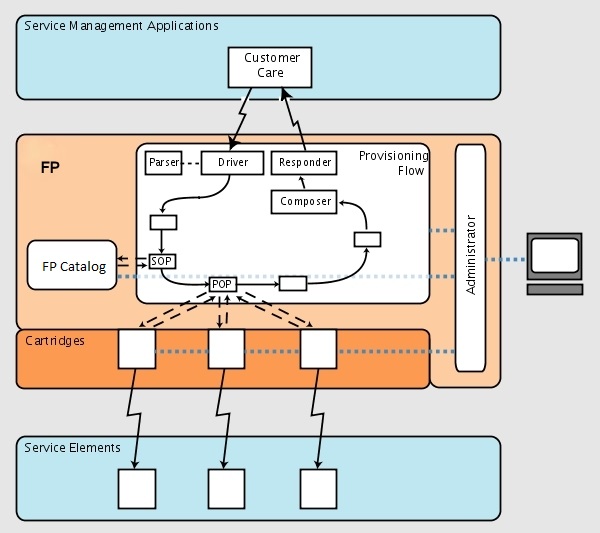
Provisioning flow: Is made up of standard Streams modules and special Fulfillment Provisioning Streams modules.
Fulfillment Provisioning Catalog: Used to decompose product orders into corresponding technical product orders and to arrange and sequence them according to defined rules.
Fulfillment Provisioning Administrator: Provides administrative access to the provisioning flow, Fulfillment Provisioning Catalog, and cartridges being used.
Cartridges: Execute work orders on actual service elements.
The following figure shows these components and their relationships to each other and to the external system.
Figure 2. Fulfillment Provisioning Architecture Overview
Provisioning Flow
The provisioning flow is a Streams application. It contains general-purpose Streams modules such as reservoirs, flow controllers, and terminators. In addition, it also contains special-purpose Fulfillment Provisioning modules. Fulfillment Provisioning modules include drivers, composer/responder pairs, Service Order Processing(SOP), Product Order Processing (POP), checkpoint handling, and other pre-built or custom-built modules.
For provisioning flow details, see the Streams and Provisioning Flow section in TIBCO Fulfillment Provisioning Developers Guide.
Fulfillment Provisioning Catalog
Fulfillment Provisioning Catalog accepts a service order with attached product orders. It decomposes the product orders into corresponding technical product orders. Subsequently, the catalog produces a set of fully populated, sequenced, mapped, routed product orders defining the provisioning tasks that need to be performed. The Service Order Processing (SOP) module, which is a part of the Provisioning Flow, invokes Fulfillment Provisioning Catalog.
The way that Fulfillment Provisioning Catalog transforms product orders into a set of technical product orders is fully configurable.
For Fulfillment Provisioning Catalog details, see TIBCO Fulfillment Provisioning Developers Guide .
Administrator
The administrator provides administrative access to Fulfillment Provisioning elements and cartridges that are installed. The administrator is accessed from a Web browser. The access to specific elements will depend on the security definitions configured for the system.
Cartridges
Cartridges provide a framework to manage connections with lower level network elements, or session layers, such as, Voicemails, Intelligent Network and so on. They provide an interface between Fulfillment Provisioning and network elements. Fulfillment Provisioning decomposes high level orders to low level orders and sends them to Cartridges. Subsequently, cartridges translate these tasks into concrete messages and sends them to specific network elements.
Cartridges accommodate any kind of network element. For example, UDP, TCP, Telnet, and HTTP adapters.
Fulfillment Provisioning provides a web interface as well as a command-line interface to maintain cartridges. For more information on using managing cartridges, refer to Cartridge Maintenance Commands. For more information on maintaining cartridges using the user interface, refer to Maintaining Cartridges.
States of a Cartridge
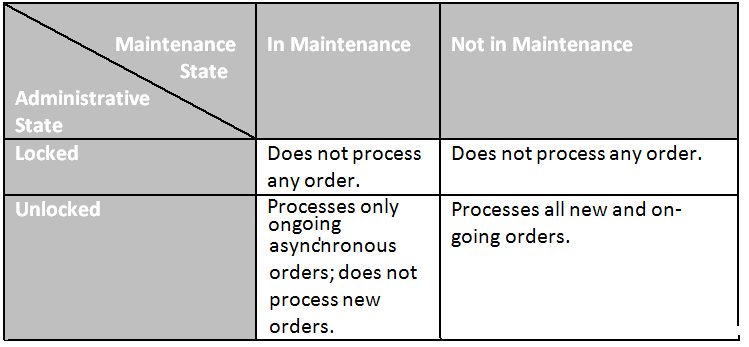
A cartridge in maintenance can be in any or all of the following three states: operational, administrative, and maintenance.
 
When a disabled cartridge is enabled, the administrative and maintenance states helps decide the course of action on work orders. The following table illustrates how the work orders are handled:
States of cartridge
Processing Asynchronous Orders
When a cartridge sends a request, but receives the response on a server started by the cartridge, the behavior is considered to be asynchronous. When in maintenance, asynchronous orders are processed on priority over new service orders. A cartridge processes asynchronous orders using the following steps:
Procedure 
1.
2.
3.
4.
5.

Copyright © Cloud Software Group, Inc. All Rights Reserved