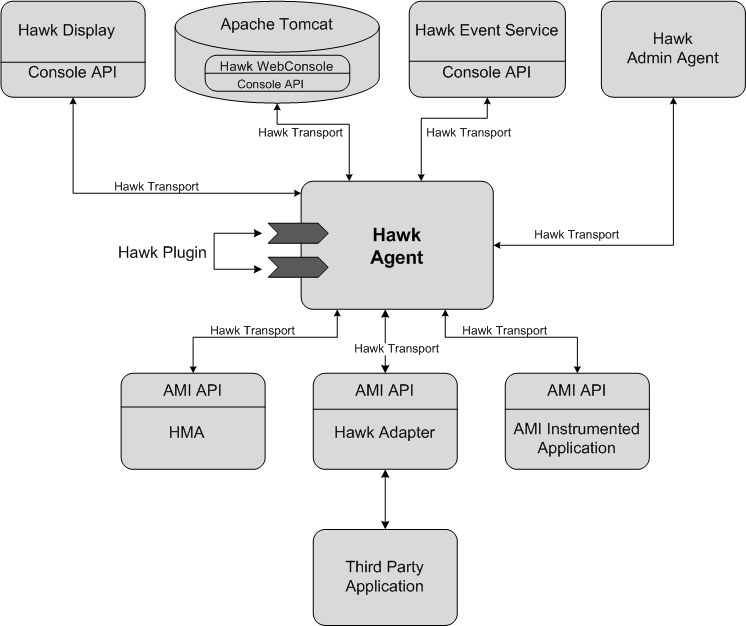
A TIBCO Hawk Agent is an autonomous process that should be installed on each computer to monitor systems and applications on that computer. The Hawk Agents operate autonomously and use sets of rules, called “Rulebases”. These rules help Hawk agents to configure system management, status reporting, and automation tasks. For more information, refer to
Chapter 2, About TIBCO Hawk Agents.
The term microagent is a generic term used to refer to the Hawk managed set of methods exposed by an application. This is done using either instrumenting the application using Hawk AMI API, or via a Hawk plug-in, or via an adapter. See the following sections for a short description of each of them. The MicroAgent is covered in more detail later on in this book.
The TIBCO Hawk Microagent or HMA is a standalone partner process to the Hawk Agent and provides various methods to the Hawk agent to instrument and monitor the host operating system and applications. The HMA is an application that uses the Hawk AMI application programming interface (API) for instrumentation. The AMI API details are provided in the section below.
The TIBCO Hawk WebConsole application is a web application that provides a central view of all the distributed components interacting within Hawk System. It is a pictorial view of each of the infrastructure component that is being monitored with the help of Hawk components.
Hawk WebConsole application itself is a Hawk Console-API based application; yet enables the users to monitor various Hawk Agents, Microagents and other Console-API based custom applications. Typically one instance of the WebConsole web application is sufficient to manage multiple Hawk domains and agents within those domains. For more information, refer to
TIBCO Hawk WebConsole User’s Guide.
The TIBCO Enterprise Administrator (TEA) is a central administration console that provides multiple products to be configured and administered. Hawk provides an agent for TEA (the TIBCO Hawk Admin Agent) which, when registered with the TEA server, allows you to monitor and do the Hawk administration from within the TEA web user interface. Using the Admin agent, you can get a consolidated view of all the distributed infrastructure components interacting within the TIBCO Hawk system. Admin Agent provides pictorial details of each of the components and allows basic monitoring and management via alerts and rules.
TIBCO Hawk Application Management Interface (AMI) is a set of API that allows developer community to extend and enhance instrumentation of various infrastructure components in the network by plugging into the Hawk system and making their applications manageable via the Hawk Agent. For more information, see the
TIBCO Hawk Programmer’s Guide.
TIBCO Hawk plug-ins are Java components that reside and run inside the process space of a Hawk Agent. They are used to connect to a third party application using its specific protocols and expose them as microagents to Hawk, thereby enabling them to be managed by Hawk. TIBCO Hawk installation provides TIBCO Hawk EMS Plug-in and Hawk JVM Plug-in. For more information, refer to
TIBCO Hawk Plugin Reference Guide.
TIBCO Hawk Adapter is similar to the Hawk Plug-in in terms of interfacing a 3rd party application as a microagent, except that it runs outside the process space of the Hawk Agent. It runs as a standalone process that adapts the application specific management and monitoring protocols to the Hawk System by using the Hawk AMI API.
TIBCO Hawk Event Service is a Console API-based application that records activities of TIBCO Hawk Agents. The Event Service logs all TIBCO Hawk system events such as agent activation and expiration, alerts, clears, and Microagent and rulebase changes. It writes entries on these activities to data files which can be accessed by external applications. It can also execute a user-supplied script to notify system administrators of an expired agent. When communication with an agent is lost, the Event Service can invoke a user-provided script. Alerts and notifications can be recorded to log files or a database.
TIBCO Hawk provides a choice of message and event communication mechanisms for inter process communications between various Hawk components.
You can choose one of the following as the primary message transport mechanisms to communicate between Hawk Agents and Console-API based console application such has Hawk WebConsole or Hawk Display (deprecated in Hawk 5.0).
|
•
|
TIBCO Rendezvous (Default message transport mechanism for Hawk, but need to be installed separately)
|
TIBCO Rendezvous (RV) allows distributed applications to exchange data across a network. TIBCO RV provides software applications robust support for network data transport and network data representation. It is supported on many hardware and software platforms. Hence it is possible to communicate seamlessly among various application programs running on a variety of computers architecture and operating systems in a network. Please refer to TIBCO Rendezvous documentation for details.
|
•
|
TIBCO DataGrid (Distributed as part of the standard Hawk installation)
|
TIBCO DataGrid is a peer-to-peer distributed in-memory data grid. It is a form of virtual shared memory that is replicated on distributed devices and applications. It also provides an application programming interface (API) that allows developers to store and retrieve data to and from the grid similar to a database as well as provide messaging capabilities, and implement database like and messaging functionality.
TIBCO EMS product is a high-performance implementation of JMS specifications and employs a store-and-forward architecture. It supports both queue-based and publish/subscribe messaging, local messaging transactions (in which multiple messages may be sent or consumed as an atomic unit of work), message selectors, and much more. Refer to TIBCO EMS Documentation for details.