Gauge Widget
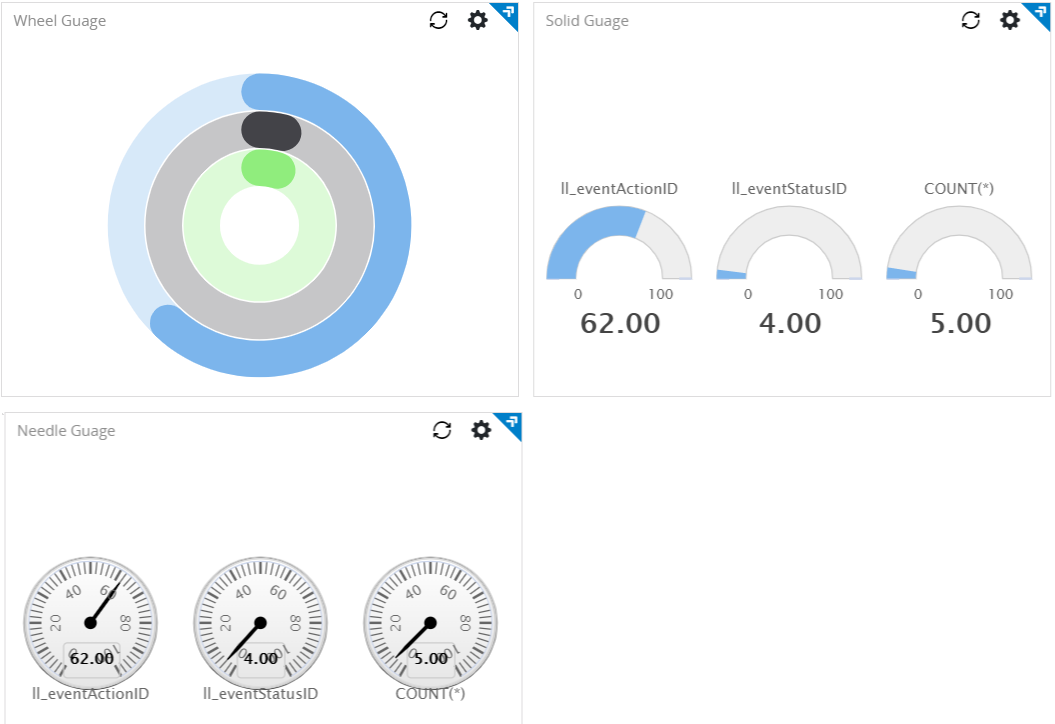
Gauge chart displays information in the form of a dial. The values of selected columns can be displayed using a needle, as concentric circles, or like a speedometer.
Use the following information to configure the widget:
| Field | Description |
|---|---|
| Fetch data from source | |
| Query | Enter a search query.
You can search based on filter and time Bloks as well. After you enter the search query, the columns from the query are used as field options in the For more information about EQL search syntax, see Event Query Language Reference. |
| Date & Time | You can enter absolute and relative time ranges.
For example, enter -5h as a relative time range to display results for events that occurred in the past 5 hours. For more information and examples, see Time Range Expressions. |
| Gauge type | Select the type of gauge:
Default: Needle |
| Show value of | Select the columns to be displayed. You can select up to three columns of numeric type.
|
| Unit label | Type the desired unit. |
| Range | Specify the range values to define the size of the |
| Threshold | After selecting the Threshold check box, you can specify the threshold value. The
color on the chart depends on the threshold values.
|
| Widget description | Enter a short description for the widget. The description is displayed on the Advanced Dashboard when you hover over the widget. |
| Auto load | Turn on the toggle to automatically load widget data on the Advanced Dashboard as soon as you save the widget or when you navigate to the dashboard. Disabling the Auto load option also disables the Auto refresh option. However, you can manually refresh the widget on the Advanced Dashboard to load its data. Default:
|
| Auto refresh | Turn on the toggle to refresh the widget every few seconds. This setting is enabled only if the Auto Load option is enabled. Default: OFF |
| Refresh widget every | If Auto refresh is set to ON, then enter a time interval in seconds to refresh the widget. Refresh action starts after the data is completely retrieved and displayed. |
Example
For the search query:
USE Other_UNIX | ll_eventActionID = 62 and ll_eventStatusID = 4 | GROUP BY ll_eventActionID , ll_eventStatusIDthe Show value is ll_eventActionID , ll_eventStatusID and Count(*).