Registering an Existing Kubernetes Cluster
You must register your existing Kubernetes namespace as a data plane before you start using the different capabilities provided by TIBCO® Control Plane. Use the following steps to register your existing Kubernetes cluster as a data plane.
- If you have not already set up Kubernetes cluster infrastructure, see Setting up Kubernetes Infrastructure.
- If you have an existing Kubernetes cluster, see Preparing a Kubernetes Cluster for TIBCO Control Plane Deployment.
- Helm is installed and configured.
- You must have Data plane Manager permission. For more information, see Permissions.
- Procedure
- In the TIBCO Control Plane, click the Data Planes menu from the sidebar.
- Click Register a Data Plane.
- On the Existing Kubernetes Cluster card, click Start.
-
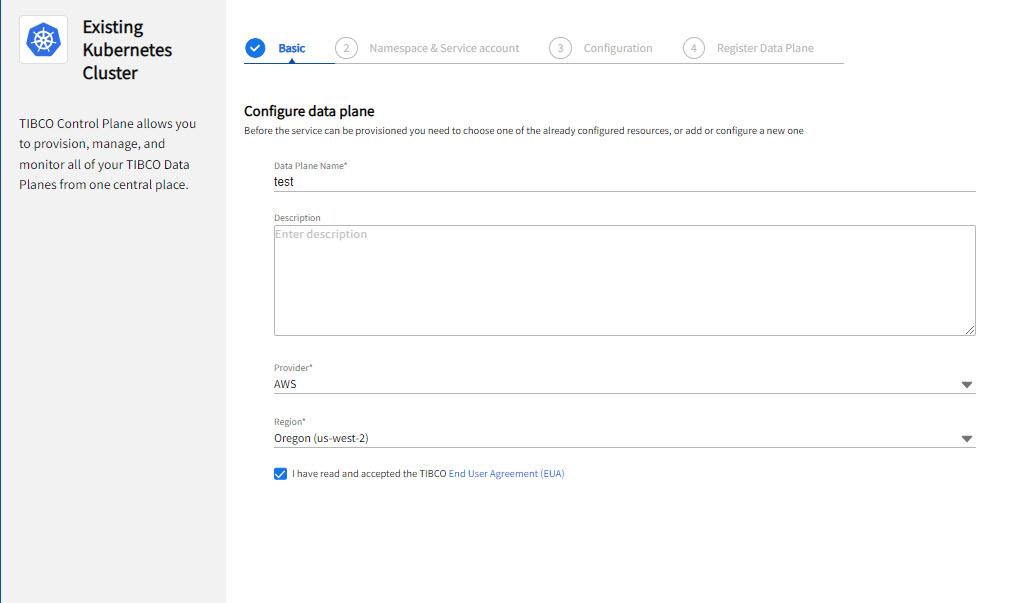
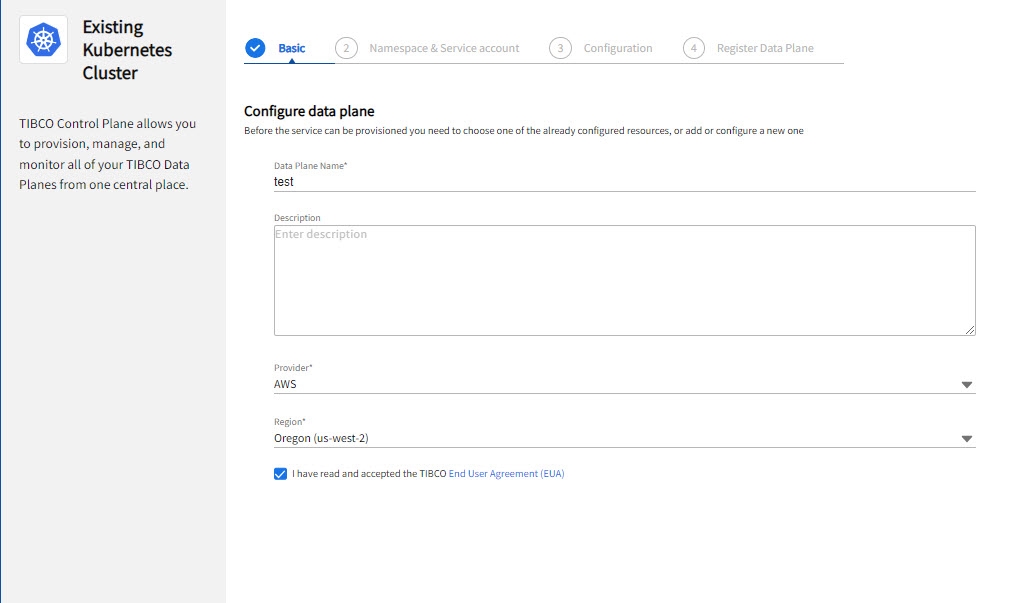
On the Basics screen, provide the following information about your Kubernetes cluster:
-
You must select the EUA checkbox before proceeding.
-
On the Namespace & Service account page, specify the following details:
Field Description Namespace Namespace in which you want to deploy TIBCO Control Plane infrastructure components and capabilities. If the namespace is not already created, you can create it by running the command on the last screen of the wizard. Service Account Specify the Kubernetes Service account name. The service account is used when deploying TIBCO Control Plane infrastructure components and capabilities. If the service account is not already created, you can create it by running the command on the last screen of the wizard. Enable or disable the cluster scoped permissions for RBAC By default, the service account has cluster-scope permissions. If you do not want service account to have cluster-scope permissions, disable the Allow cluster scoped permissions option.
If cluster-scoped permissions are disabled, cluster-scoped RoleBindings are not created. It creates namespace scoped Role and RoleBindings, which only apply to resources in every namespace. For more information, see Data Plane RBACs.
-
On the Configuration page, the following configurations are available:
Field Description Logs Processing Deployment of fluentbit sidecar for Services logs (Optional) By default, Fluentbit log processing is enabled. If you disable this option, the logs from the data plane are not captured and forwarded to the log processor configured in the observability resource. If your organization's current infrastructure already captures logs from all workloads, then you can disable this feature to reduce resource consumption. After registering a data plane, you cannot edit this configuration.
This option is available from UI for TIBCO Operated Control Plane. For self-hosted TIBCO Control Plane, you must set this option in the
platform-bootstrapchart.Proxy (Optional) You can use a proxy server to route your outbound requests through the proxy server. By default the proxy configuration is disabled.
Specify values for either HTTP PROXY or HTTPS PROXY.
HTTP Proxy A proxy URL to use for creating HTTP connections outside the data plane.
The format for the HTTP proxy is:
http://http_proxy:portExample:
http://proxy.example.com:8080HTTPS Proxy A proxy URL to use for creating HTTPS connections outside the data plane.
The format for the HTTPS proxy is:
https://https_proxy:portExample:
http://proxy.example.com:8084No Proxy NO_PROXY value defines a list of destination URLs to exclude from using the proxy.
The format of NO_PROXY is:
https://no_proxy1:port,https://no_proxy2:portContainer Registry (Optional) By default, TIBCO Control Plane uses JFrog registry for all component Docker images. This section is to provide the custom container registry details from where to pull the docker images. You must ensure to download the images from TIBCO default registry and push them to your custom registry. For the list of images need to be pushed to your custom registry, see Pushing Images to Custom Container Registry. Registry URL The URL of the container registry.
Example:
registry.acme.ioRepository The name of the repository Username The username to access the container registry. Password The password to access the container registry. -
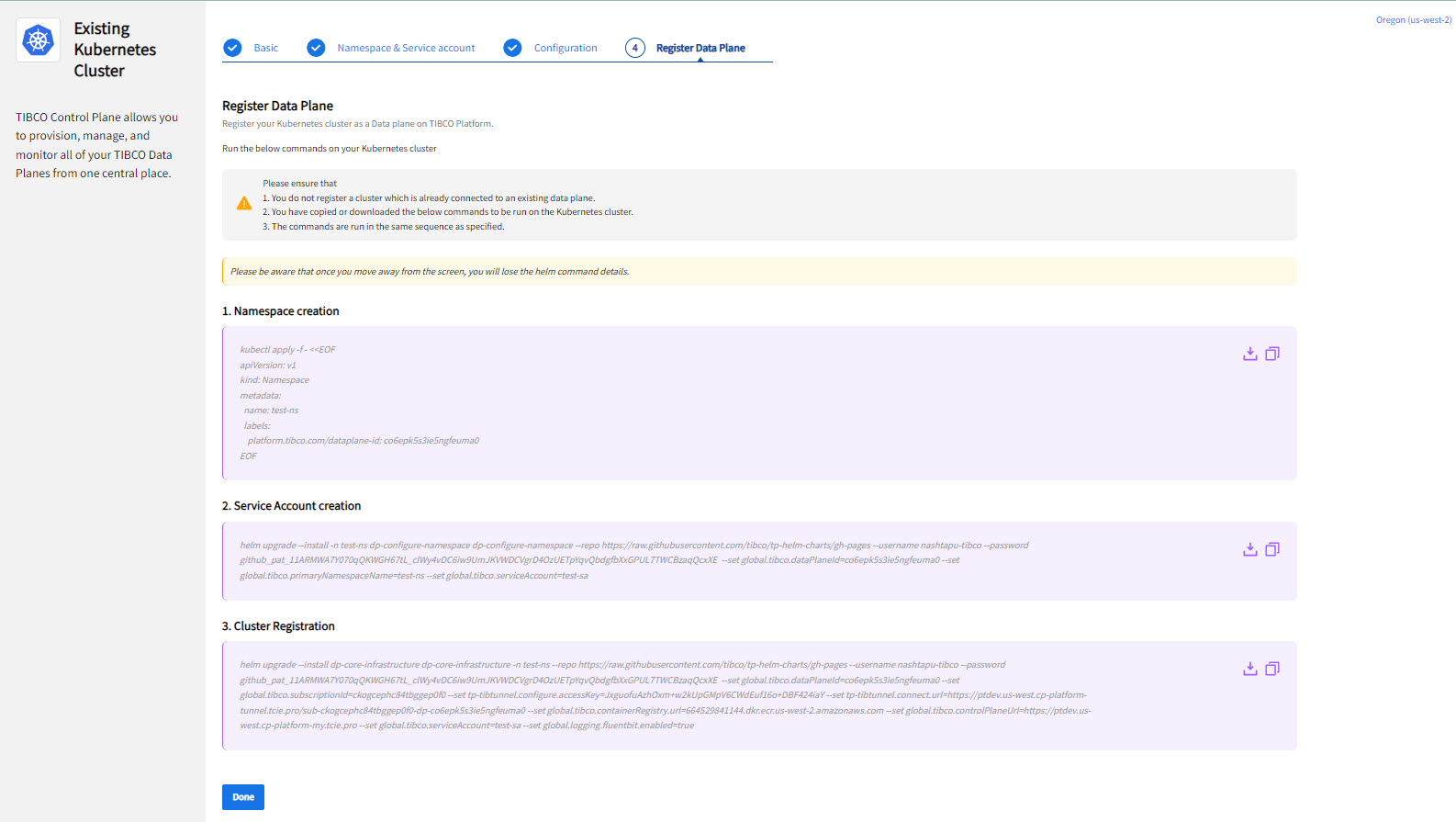
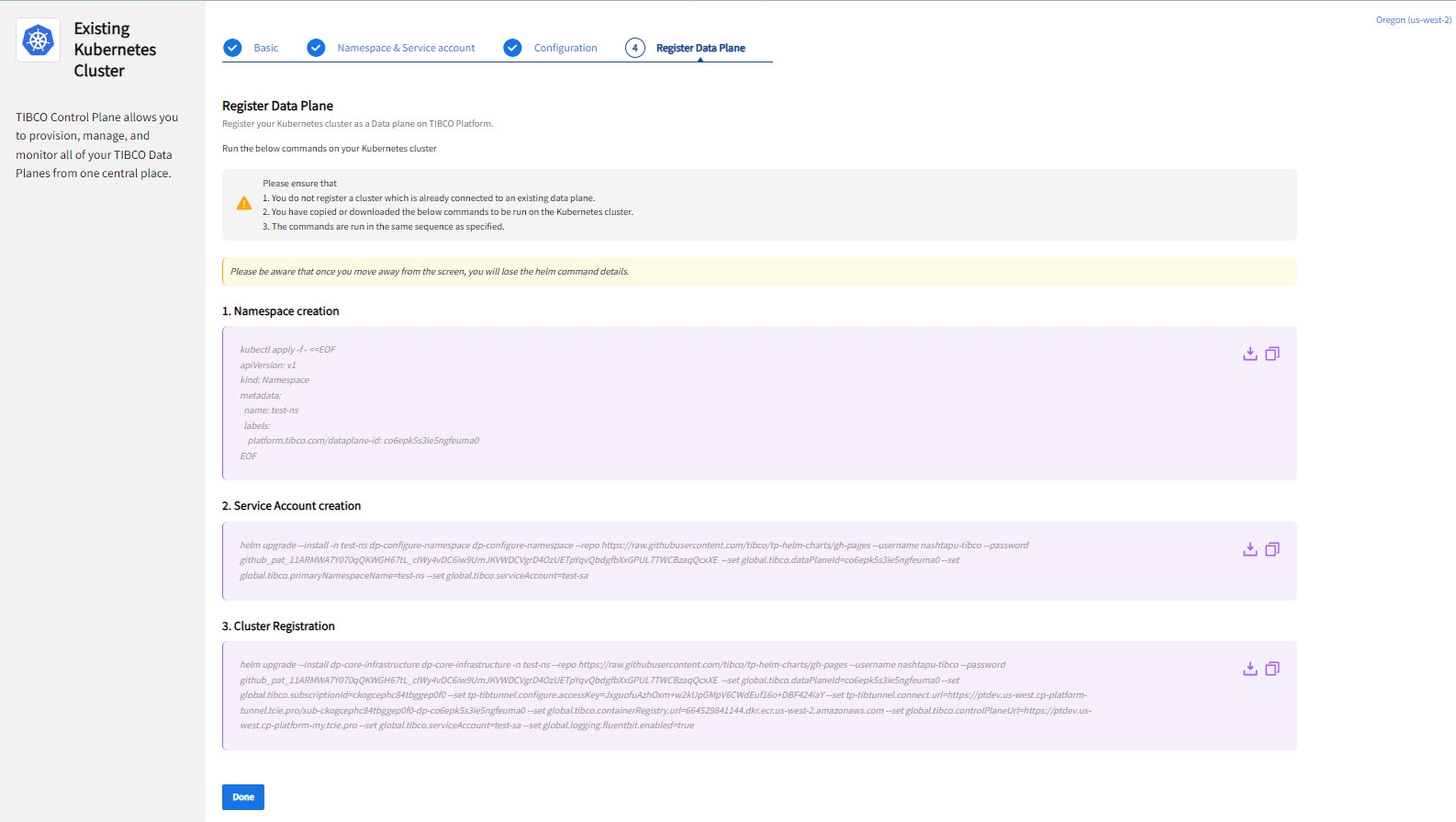
On the Register a Data Plane page, the helm commands for namespace creation, service account creation, and cluster registration are displayed. Run the helm commands in your Kubernetes cluster in the sequence specified on the screen. It is mandatory to run all three commands whether you have an existing namespace and service account or you want to create a new one. If you are using an existing namespace, you can skip the namespace creation step and instead apply label to
platform.tibco.com/dataPlane-id:<data plane id>to the existing namespace.Cluster Registration command deploys TIBCO Control Plane Infrastructure components in your Kubernetes cluster. These commands are required to manage and monitor the data plane by using TIBCO Control Plane.
Optionally, to enable the creation of default network policies, see Data Plane Network Policies.
Note: The Helm commands are unique for each data plane. Copy or download the commands before clicking Done. Because after you close this screen, you cannot access the Helm commands, and you need to follow the previous steps again.