Subject-based addressing technology helps messages reach their destinations without involving programmers in the details of network addresses, protocols, hardware and operating system differences, ports and sockets. Subject-based addressing conventions define a simple, uniform name space for messages and their destinations.
Programs that produce data arrange that data into messages, label each outbound message with a subject name, and send those messages. Programs that consume data receive it by
listening to subject names; a consumer listening to a subject name receives all messages labeled with that name, from the time it begins listening until it stops listening.
A subject name is a character string that specifies the destination of a message, and can also describe the message content. For programs to communicate, they must agree upon a subject name at which to rendezvous (hence the name of this product). Subject-based addressing technology enables
anonymous rendezvous, an important breakthrough, which decouples programs from the network addresses of specific computers.
Subject names consist of one or more elements separated by dot characters (periods). The elements can be used to implement a
subject name hierarchy that reflects the structure of information in an application system.
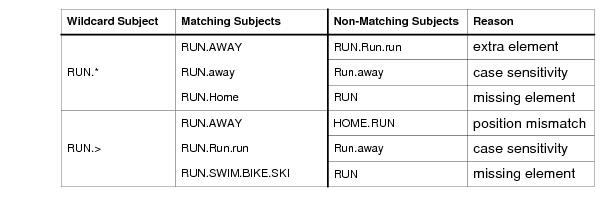
A program can receive a group of related subjects by listening for a wildcard subject. The following examples illustrate wildcard syntax and matching semantics. (For further examples, see
Subject Name Syntax.)
An inbox name specifies a destination that is unique to a particular process. Rendezvous software uses point-to-point techniques to deliver messages with inbox subject names. See also:
