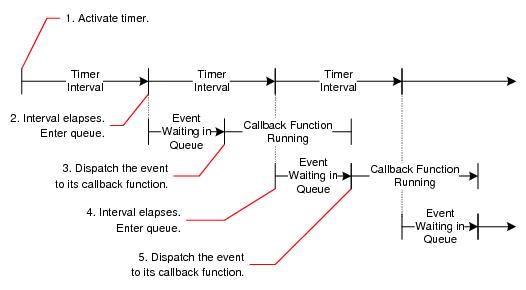
When a program creates a timer event object, the creation call activates the timer event—that is, it requests notification from the operating system when the timer’s interval elapses. When the interval elapses, Rendezvous software places the event object on its event queue. Dispatch removes the event object from the queue, and runs the callback function to process the timer event. On dispatch Rendezvous software also determines whether the next interval has already elapsed, and requeues the timer event if appropriate.
Figure 12 illustrates a sequence of timer intervals. The number of elapsed timer intervals directly determines the number of event callbacks.
Destroying or invalidating the timer object immediately halts the sequence of timer events. The timer object ceases to queue new events, and an event already in the queue does not result in a callback. (However, callback functions that are already running in other threads continue to completion.)
Resetting the timer interval immediately interrupts the sequence of timer events and begins a new sequence, counting the new interval from that moment. The reset operation is equivalent to destroying the timer and creating a new object in its place.