Modeling functions
The list shows the modeling functions that you can use in expressions.
See also Arps decline curve on the Curve fit models page for more information.
| Function | Description |
|---|---|
Arps(Arg1,
					 Arg2,
					 Arg3,
					 Arg4, (Arg5))
|
Calculates production using the Arps model,
given t, qi, b, Di, and optionally, Dlim.
If Dlim is provided, the Modified Arps equation is used, otherwise the Standard Arps equation is used. If b is an empty value (null), it is treated as 0.0, which corresponds to an Exponential decline. Example:
|
ArpsCumulative(Arg1,
					 Arg2,
					 Arg3,
					 Arg4, (Arg5))
|
Calculates the cumulative production for the
Arps model given t, qi, b, Di, and optionally,
Dlim.
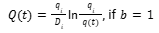
If Dlim is provided, the Modified Arps equation is used, otherwise the Standard Arps equation is used. If b is an empty value (null), it is treated as 0.0, which corresponds to an Exponential decline. The cumulative production is the integral of the production
from time zero to the given time t. It can be evaluated using the
formulas:
  Example:
|
ArpsEffectiveToNominalDecline(Arg1,
					 Arg2)
|
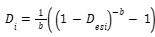
Converts the secant effective initial
decline rate to the nominal initial decline rate Dᵢ, given the Arps exponent b.
 Example:
|
ArpsNominalToEffectiveDecline(Arg1,
					 Arg2)
|
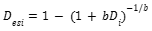
Converts the nominal decline rate
Di to the effective decline rate Desi, given the Arps
exponent b.
 Example:
|
ArpsNominalToTangentEffectiveDecline(Arg1)
|
Converts the nominal decline rate
Di to the tangent effective decline rate.
 Example:
|
ArpsTangentEffectiveToNominalDecline(Arg1)
|
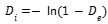
Converts the tangent effective decline rate
to the nominal decline rate Di.
 Example:
|
ArpsTimeAtDecline(Arg1,
					 Arg2,
					 Arg3)
|
Calculates the time for an Arps decline
curve to reach a target nominal decline rate Dlim, that is, the
point where the curve switches over to become exponential. The arguments are b,
Di, and Dlim.
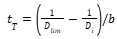 Example:
|
ArpsTimeAtRate(Arg1,
					 Arg2,
					 Arg3,
					 Arg4,
					 Arg5)
|
Calculates the time for an Arps decline
curve to reach a certain production. The arguments are qi, b,
Di, Dlim, and qlim.
If Dlim is not an empty value (null), the Modified Arps equation is used, otherwise the Standard Arps equation is used. If b is an empty value (null), it is treated as 0.0, which corresponds to an Exponential decline. The time is given by:
  The qlim value is also known as the Economic limit. Example:
|
See also Functions.