Classifier (DB)
Uses any input classification model to apply a classification prediction to the input data set.

Information at a Glance
|
Parameter |
Description |
|---|---|
| Category | Predict |
| Data source type | DB |
| Send output to other operators | Yes |
| Data processing tool | n/a |
Algorithm
The TIBCO Data Science – Team Studio Classifier operator is used to predict the probability of the occurrence of the event based on the model generated by the training of Alpine Forest, Decision Tree, K-Means (Hadoop), Logistic Regression, Naive Bayes, Neural Network, or SVM Classification operator models.
Input
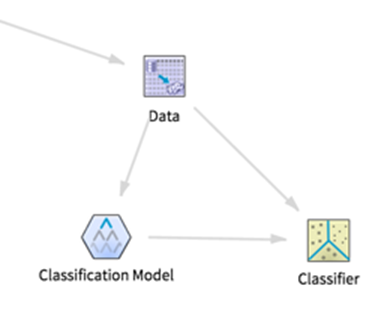
The input data set must contain the columns such that the names are the same as the columns in the data set selected for model training with the exception of the dependent column. The Classifier operator must have both of the following.
- An input Classification model.
- An input data set against which the model is applied.
The model preceding the Classifier operator can be any of the following. The Classifier operator can take multiple models from the preceding operators, not just one.
- Alpine Forest
- Decision Tree
- K-Means
- Logistic Regression
- Naive Bayes,
- SVM Classification
Configuration
| Parameter | Description |
|---|---|
| Notes | Notes or helpful information about this operator's parameter settings. When you enter content in the Notes field, a yellow asterisk appears on the operator. |
| Output Schema | The schema for the output table or view. |
| Output Table | Specify the table path and name where the output of the results is generated. By default, this is a unique table name based on your user ID, workflow ID, and operator. |
| Storage Parameters | Advanced database settings for the operator output. Available only for
TABLE output.
See Storage Parameters dialog for more information. |
| Drop If Exists | Specifies whether to overwrite an existing table.
|
Output
The Classifier outputs its prediction columns with the columns of the input data set into a prediction table location specified by user.
The data rows of the output table/view displayed (up to 2,000 rows of the data).
For example, the output for a dependent column, srsdlqncy, might look like the following.
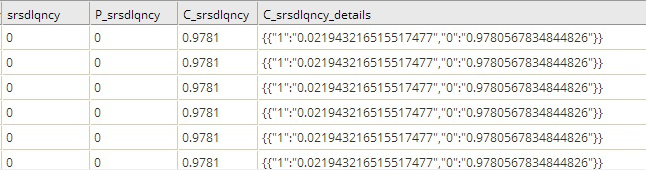
The Classifier operator outputs the following standardized three prediction columns:
- P_dependent_column_name: The predicted value which should be one of the possible returning values of the dependent column.
- C_dependent_column: The confidence of obtaining the result being the P_dependent_column_name predicted value.
- C_dependent_column_details: The confidence values associated with the dependent column's possible values.
Example