Pivoting data
A pivot transformation is one way to transform data from a tall/skinny format to a short/wide format. The data is distributed into columns, usually aggregating the values. This means that multiple values from the original data end up in the same place in the new data table.
Example
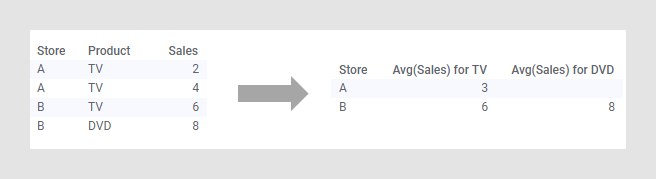
The example below shows a pivot transformation on a very simple data set. In the original data table, there are three columns and four rows. Each row contains one of two department stores, A or B; a product, TV or DVD; and a numerical value for the number of sales. The data table might look like this if a new row is added after each day.
However, perhaps we are more interested in knowing how many units of each product are sold in each store on an average day.
After pivoting the data table, using the aggregation method "average" on the numerical values for the two products, we get a new data table. This data table has just two rows, one for each store. The layout of the table has gone from tall/skinny to short/wide. Had there been more products in the data table the difference would be even more pronounced. In the new data table, it is easy to see the number of products being sold in each store on an average day. The first row tells us that on any given day in department store A, 3 TVs are sold, but no DVDs. In department store B, however, an average day might see 6 TVs and 8 DVDs sold.
Example
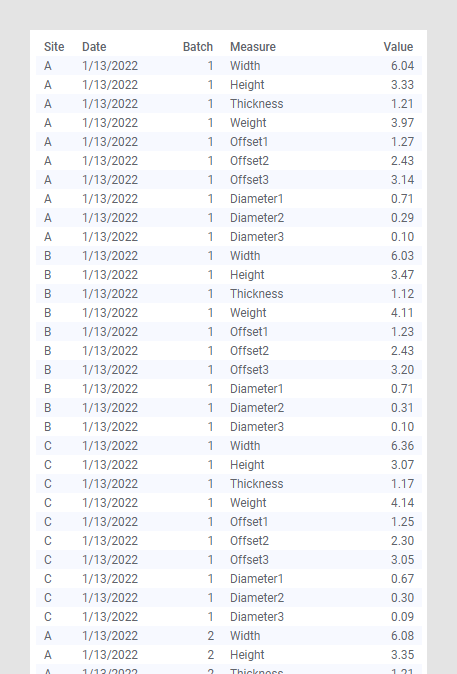
In this example, we have a larger data set, with data from an imagined company that produces small machinery parts. These parts have measurements for width, height and thickness. The parts have three different holes in them. There are also measurements for the diameter of these holes, and a measurement for a possible small offset from where they are supposed to be.

The order of the new columns is determined by the result of the naming expression, sorted in alphabetic order.
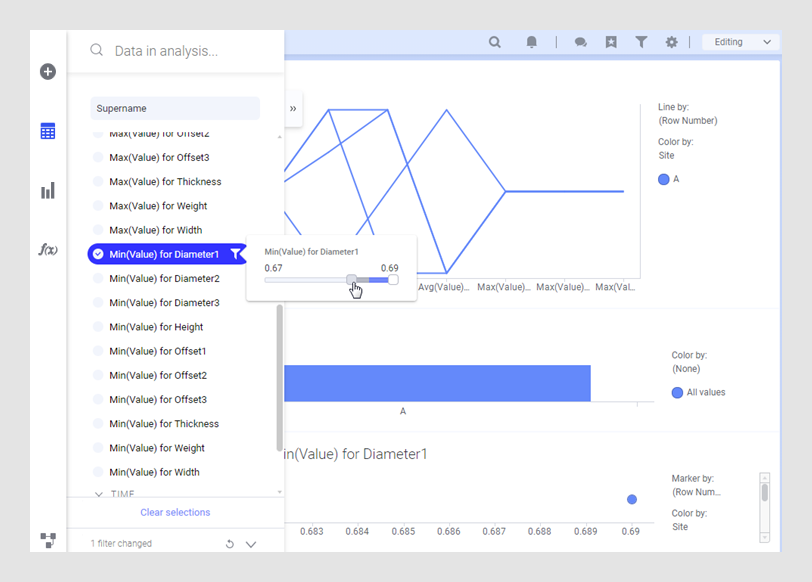
In the analysis, we can see that if the most important criterion is that the diameter is not too small, A is the factory that should supply parts to the most demanding customers.