Creating schedules
You can create and save schedules that you plan to reuse. If a schedule will only be used once, you can instead define it when you create the update rule.
About this task
See Scheduled updates to analyses for generic information on scheduled updates.
When you create a schedule, you must configure the interval when the schedule should be preloaded, specify when to update the analysis data, and set the active schedule period, among other settings. Preloading an analysis improves the initial loading time, as the analysis will be preloaded into the Web Player's memory and this minimizes the load time when someone opens it from a web browser. You can specify when and how often the server should check for changes in the analysis file or its underlying data, and reload the data if any changes are detected.
The steps below show how to create a saved schedule, but most steps are the same when you add a schedule from within the Rules page. When you add a schedule created specifically for a rule, you will only follow step 4 through 6 below. See Creating scheduled updates by using Spotfire Server for information about how to add scheduled updates rules.
Procedure
-
In the
Create schedule dialog, decide what you want the
schedule to do.
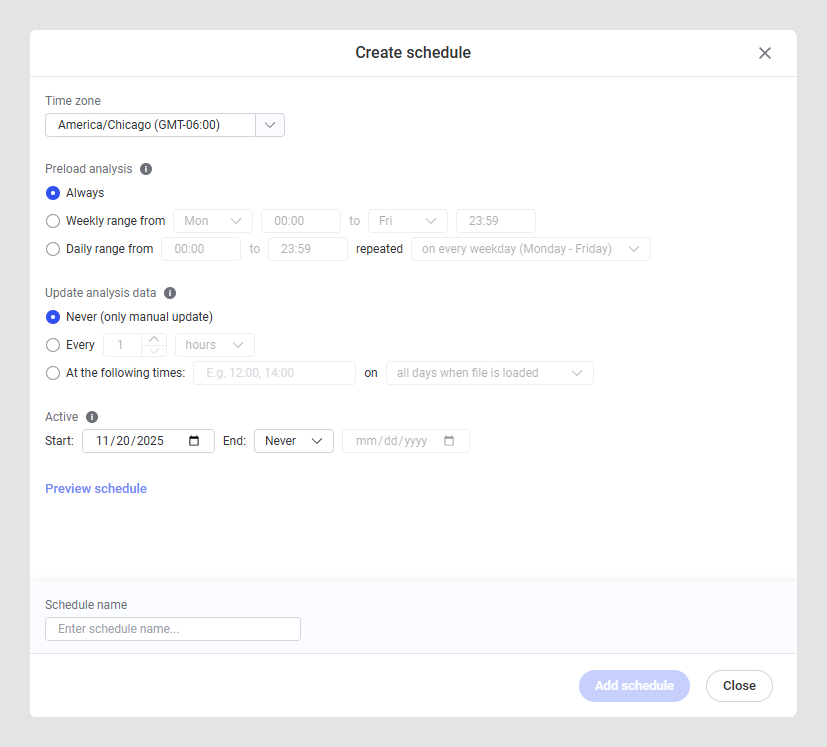
Tip: You can click Preview schedule at the bottom part of the dialog to see a list of the upcoming activities for the schedule, when using the current settings.
Results
Example: Preloading an analysis during working hours
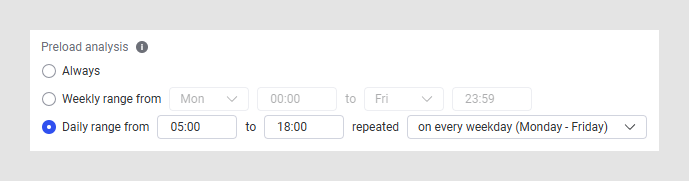
Example: Creating an overnight schedule
Use the Daily range option with a start time at (for example) 19:00, and an end time at 03:00, to keep the file loaded during the night, and specify whether to do this on every day or on some days only.
Example: Creating a daily range schedule
Use the Daily range option with the start time 00:00 and the end time 23:59 to keep the file loaded all day, and specify whether to do this on every day or on some days only.
Example: Update the analysis data at a specific time, on specific days
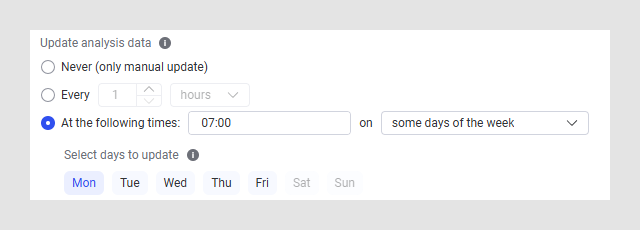
With these settings, the analysis is updated at 07:00 each Monday.
Example: Automatic conversion of schedules from previous Spotfire versions
If your Spotfire environment contains schedules and analysis update rules from a version before 14.8.0, the schedules will automatically be converted to the new format when the system is upgraded, or when previous rules are imported into an updated database (as long as the associated analysis file is present in the library before importing the rule).
In most cases, the previous schedules will work exactly the same as before, and have very similar settings, but there might be some exceptions in certain cases.
| Previous settings | Converts to |
|---|---|
| Repeat on these
days: Mon, Tue , Wed , Thu , Fri , Sat , Sun
Start loading file: 00:00 Unload file: 23:59 |
Preload analysis:
Daily range from 00:00 to 23:59 repeated
on some days of the week
Mon, Tue, Wed, Thu, Fri, Sat, Sun Repeat every 1 week |
| Start loading file: 03:00 Unload file: 03:00 | Preload analysis:
Daily range from 00:00 to 23:59
Note: If the start loading and unload times are identical, the
system automatically converts this to a Daily Range from 00:00 to 23:59.
|
| Only load new data at the start of the schedule | Update analysis data: Never (only manual update) |
| Update with new data every: x minutes (or hours) | Update analysis data: Every x minutes (or hours) |
| If no start date is available | Active: Start: today's date |
| If no end date is available | Active: End: Never |